
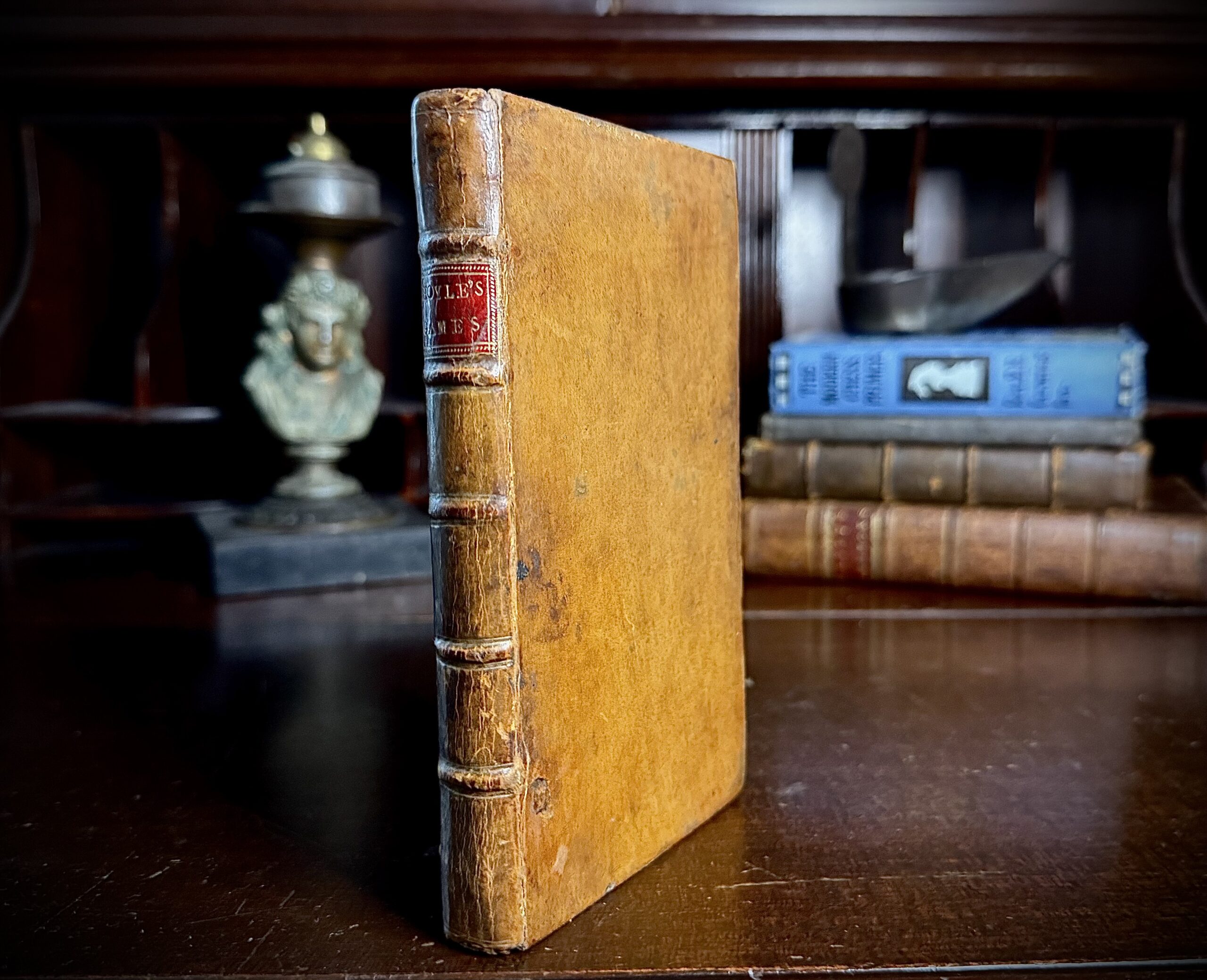
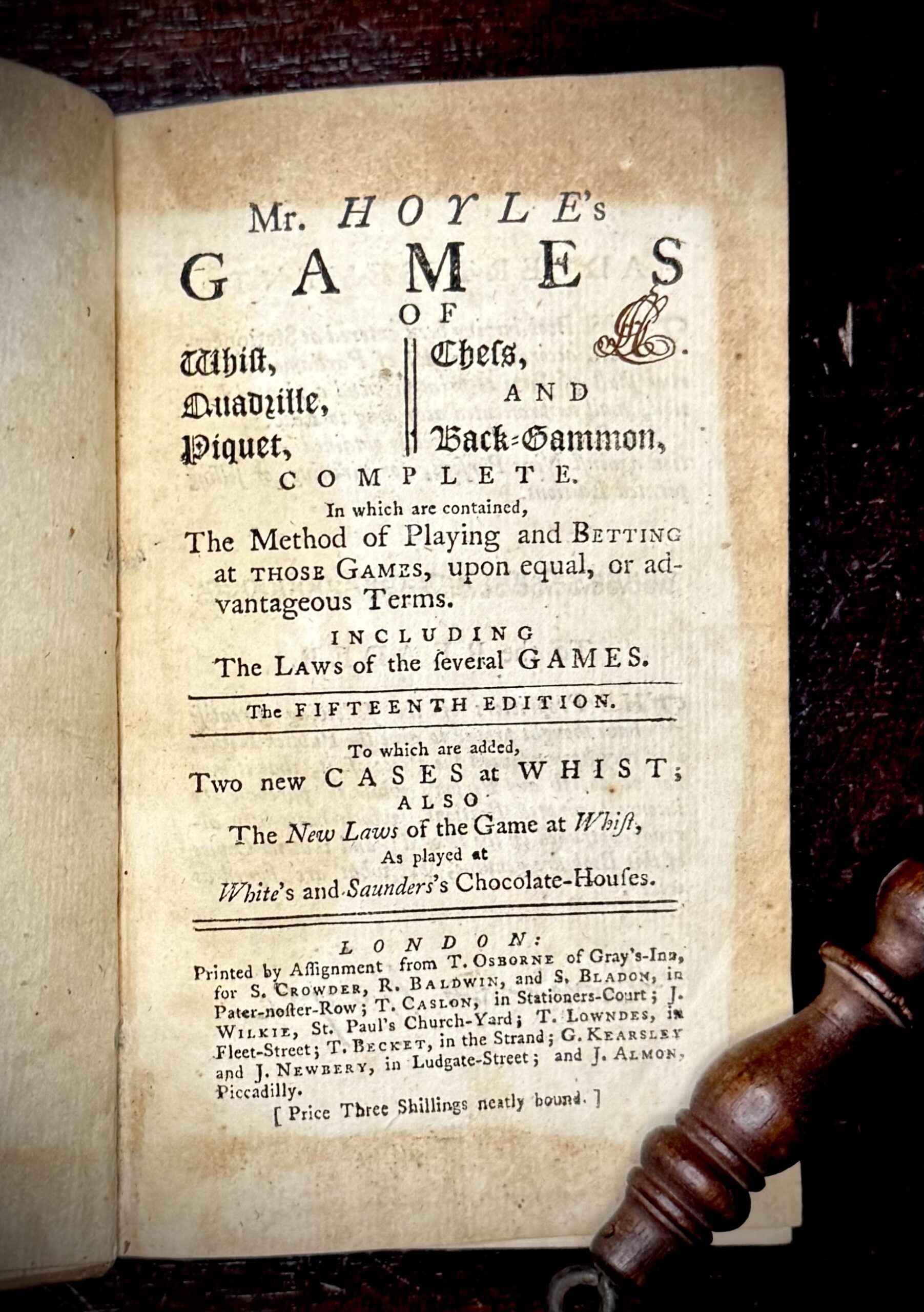
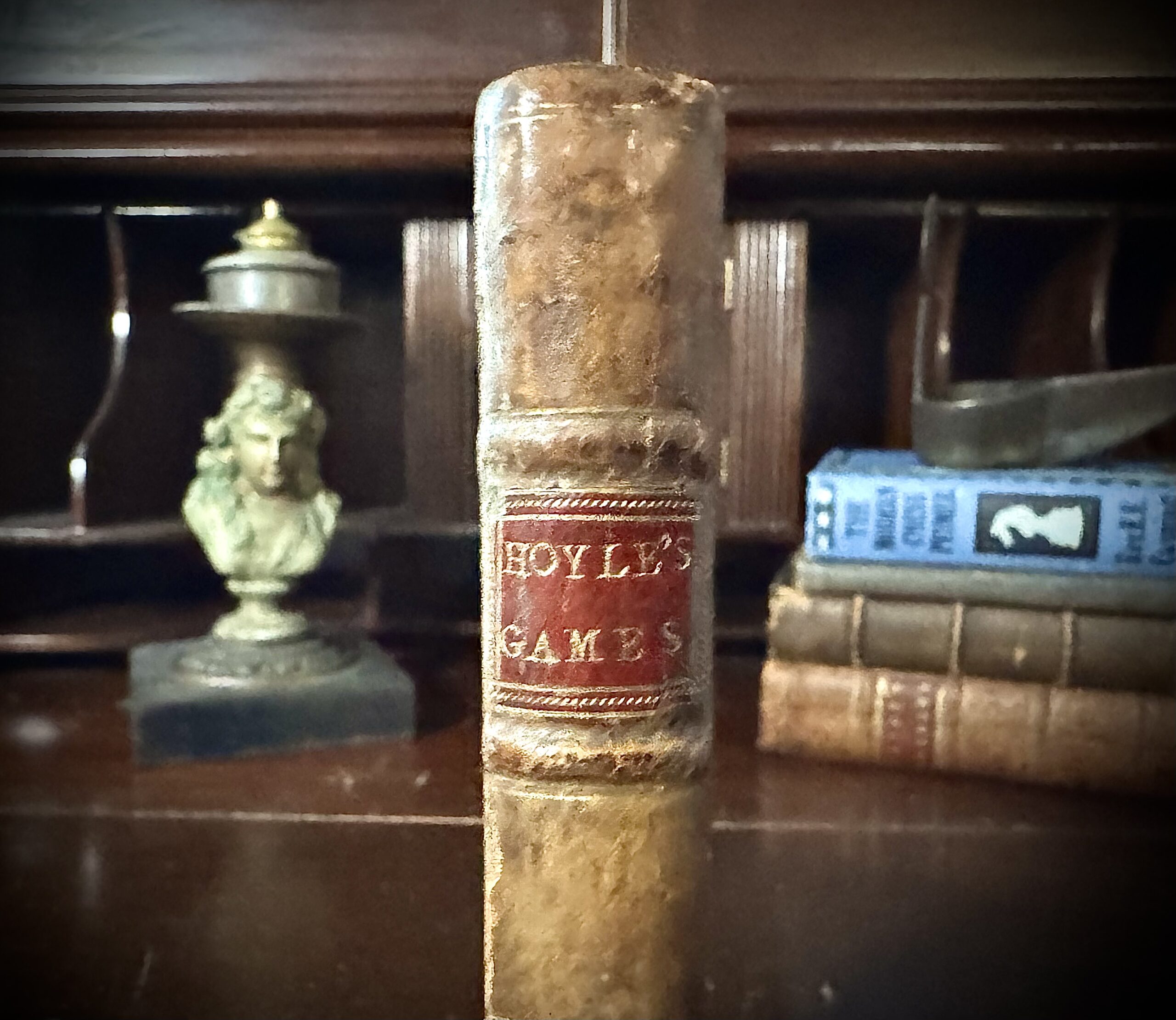
Title: Mr. Hoyle’s Games of Whist, Quadrille, Piquet, Chess, and Back-gammon, Complete
Author: Edmond Hoyle
Printed by assignment from T. Osborne
Year of printing: 1771
Notes:
This is amongst the most important books on games ever published. Edmond Hoyle (1672 – 1769) first established himself as a gaming authority by publishing his A Short Treatise on the Game of Whist in 1742. He proceeded to publish other books on individual games before finally collecting together in the first edition of this book in 1748. Prior to Hoyle, the rules for card and board games were fluid and varied by region. By formalizing semi-official rules, Hoyle standardized play across Europe and inspired the phrase “According to Hoyle,” which still today means playing strictly by the official rules.
The title page notes that the rules align with the play at White’s and Saunders’s Chocolate-Houses. At the time, chocolate was a rare, exotic luxury, and these establishments served as hubs where the elite could be served hot chocolate drinks. The wealthy customers would also play games and gamble, and so full agreement on the rules was important. Some of these chocolate houses still exist — White’s exists today as an elite gentleman’s club, which includes members such as the King and Prince of England.
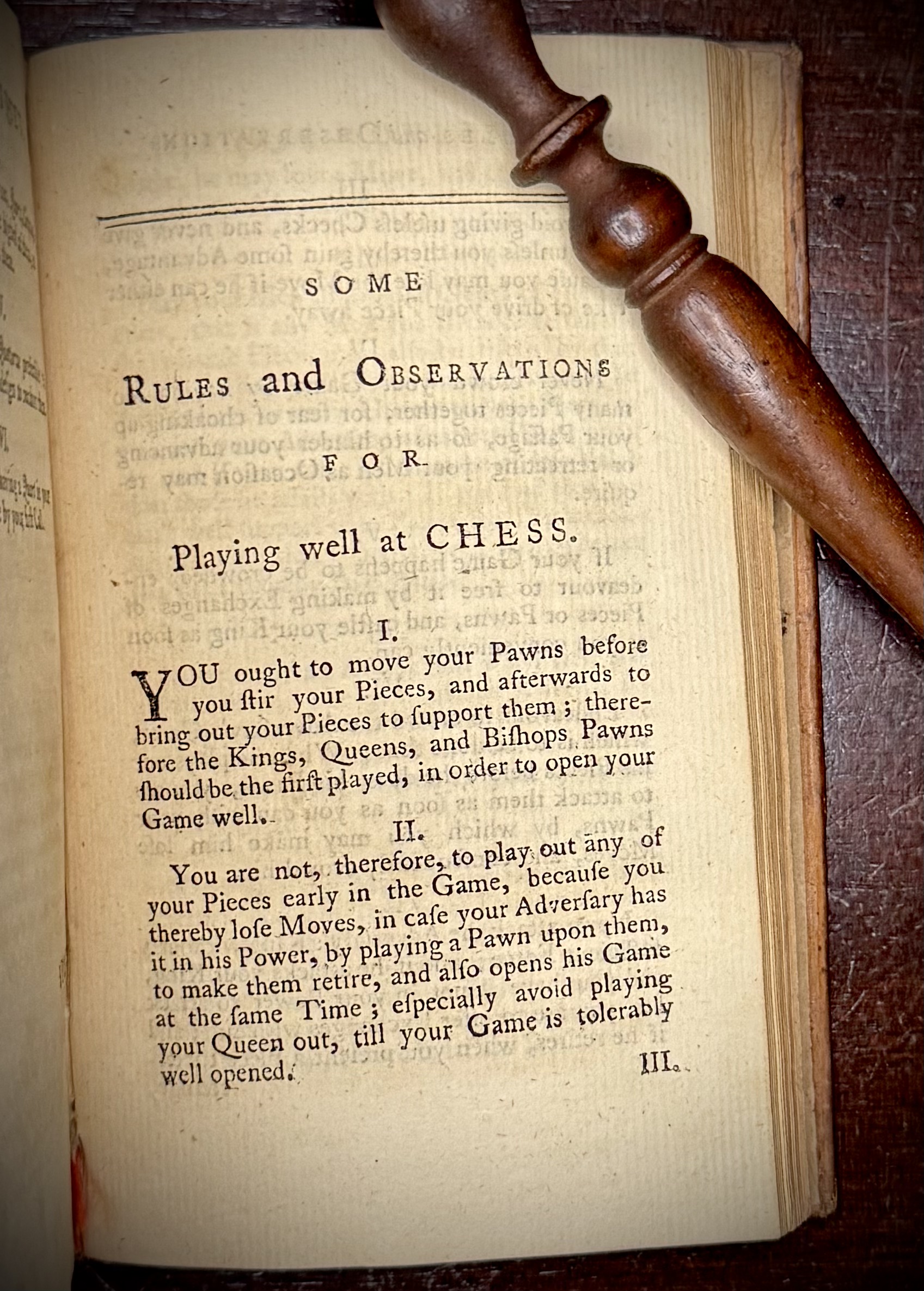
This book also serves as a fascinating time capsule. Whist was replaced by modern-day bridge, and chess was still evolving when this book was published, making its advice unhelpful for modern play. In the 18th century favored passive, slow styles, and pawn promotion didn’t allow multiple queens on the board.
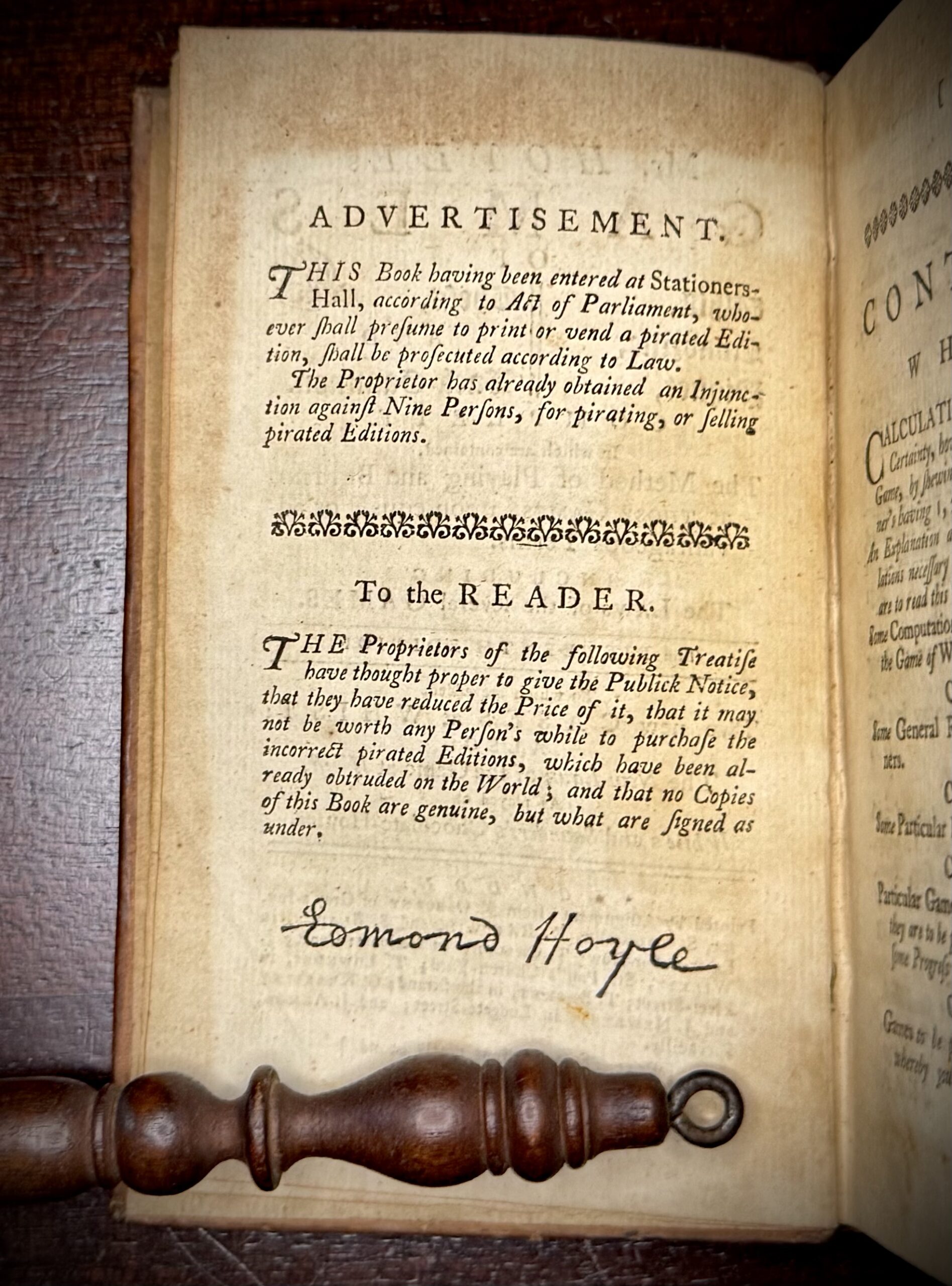
This book was so popular that it was heavily pirated. The book states “The Proprietor has already obtained an Injunction against Nine Persons, for pirating, or selling pirated Editions.” While Hoyle was alive, he personally signed every copy as proof that it was legitimate. This 15th edition was the first published after his death, but still includes a printed version of his signature. Once the copyright on this book expired in 1774, numerous imitators appeared using Hoyle’s name, often adding new games or revising text.
One interesting note, the list of printers includes “J. Newbery”, which refers to John Newbery, the 18th century publisher who innovated the genre of children’s books, and for whom the modern Newbery Award is named. However, Newbery died in 1767, so certainly did not print this book — his son and nephew, both named Francis Newbery, continued his printing business under his name.
Historical context:
When this book was published in 1771, George III was King of Great Britain. The first boardgame publishers were appearing, with games now becoming mass produced using printing techniques rather than being handmade. One of the most popular board games was “Game of the Goose”, a spiral race track game based purely on luck. Whist and chess dominated gentleman’s clubs, and chess in particular began to formalize tactics and was played obsessively by the elite such as Benjamin Franklin and Thomas Jefferson.
Further reading:
- Edmond Hoyle – Wikipedia
- ETSC entry
- Whist – Wikipedia
- Quadrille – Wikipedia
- White’s – Wikipedia
- The Rambunctious, Elitist Chocolate Houses of 18th-Century London – Atlas Obscura
- A Descriptive Bibliography of Edmond Hoyle entry
- John Newbery – EBSCO
Acquired June, 2026