
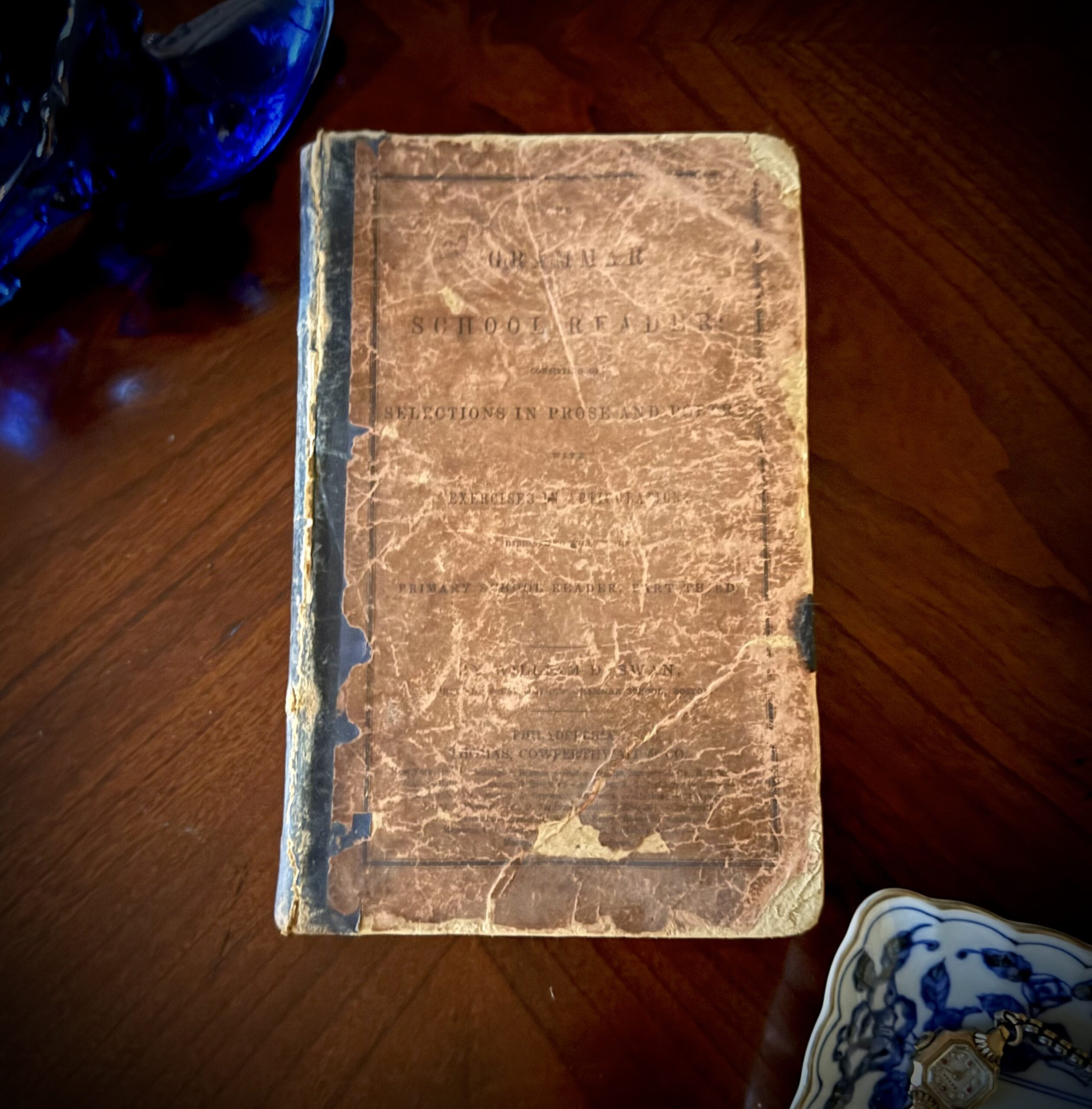
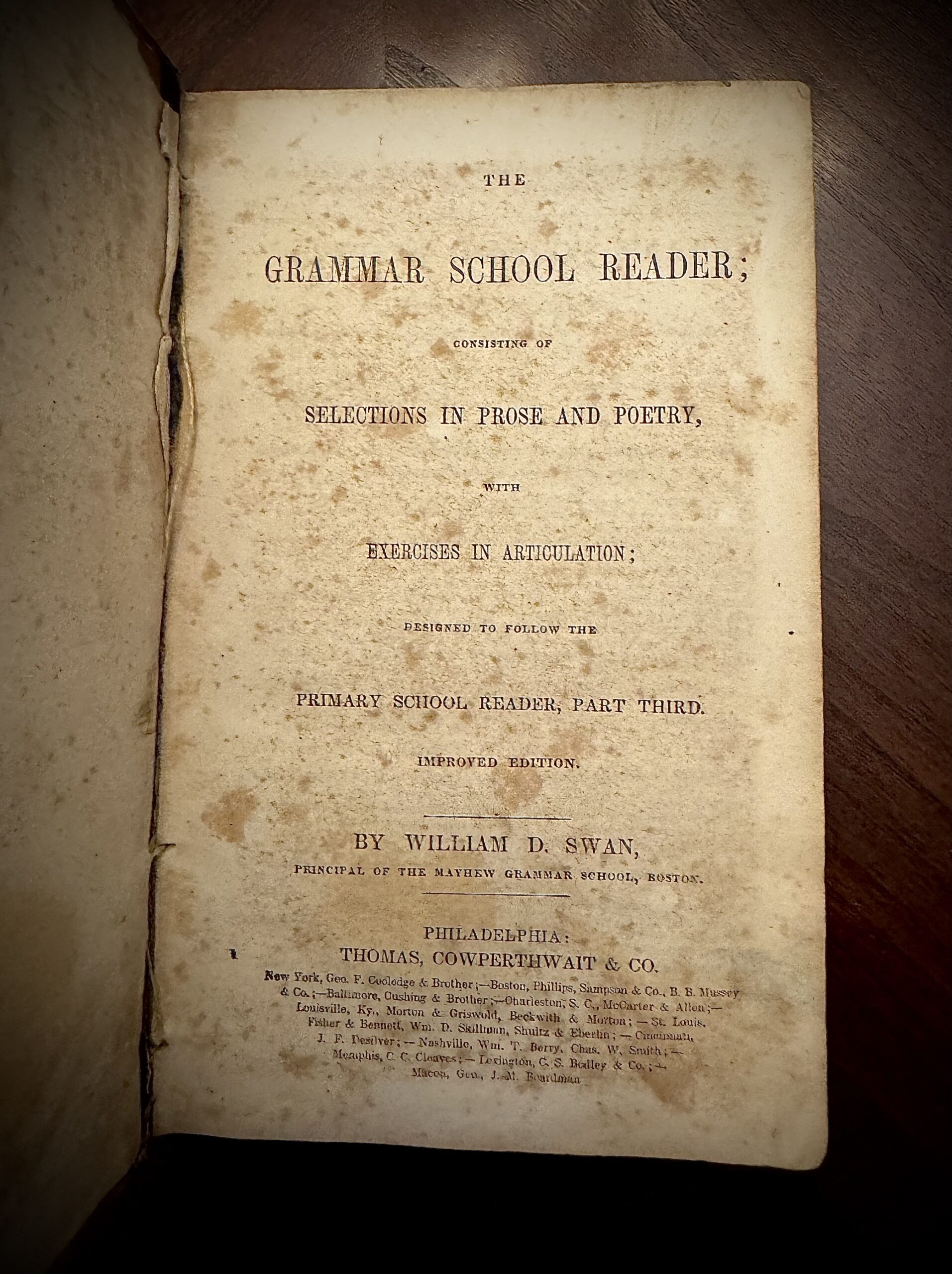
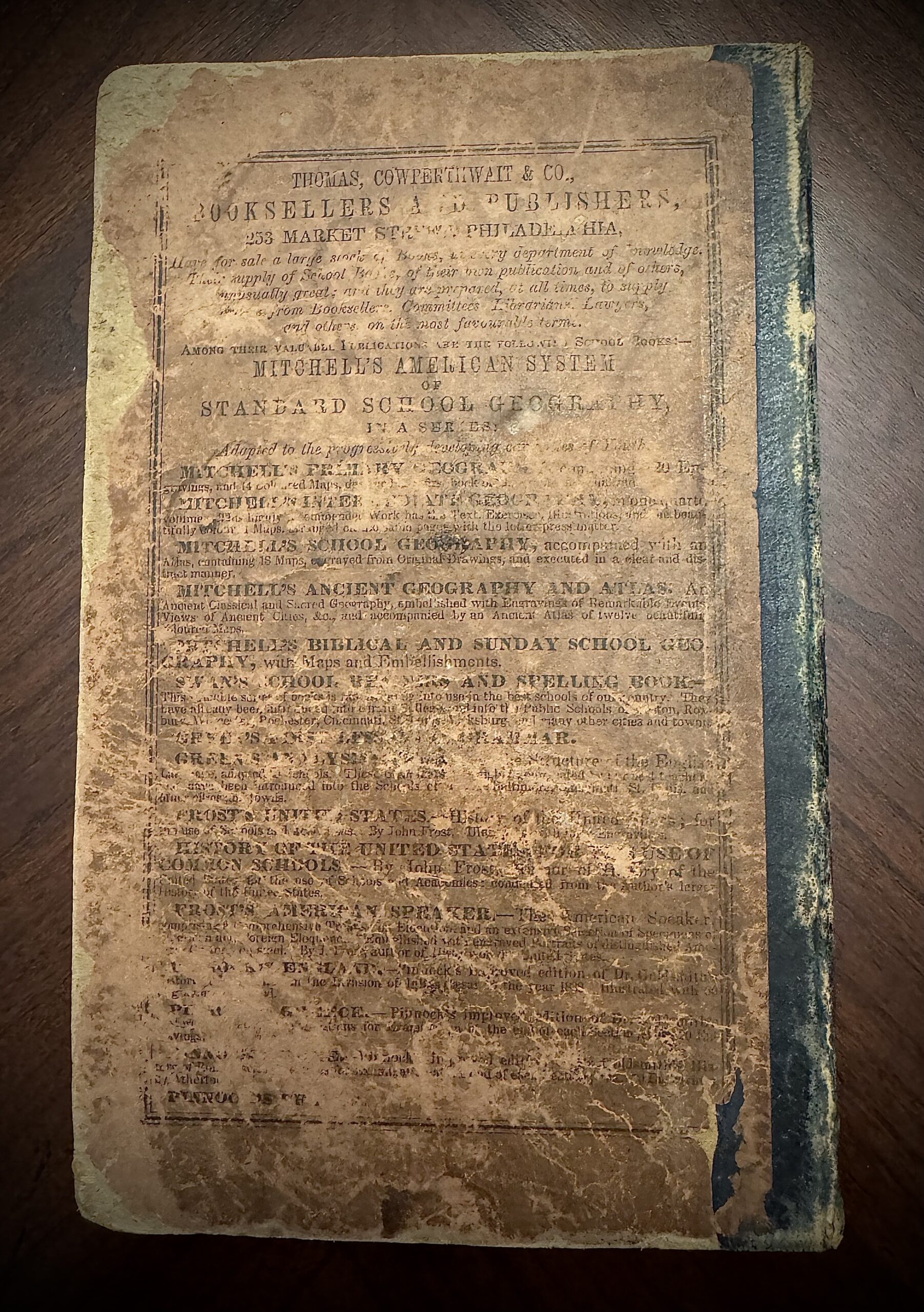
- Title: The Grammar School Reader
- Author: William D. Swan
- Publisher: Thomas, Cowperthwait & Co.
- Estimated year of printing: 1848
Notes:
Sticker: “Sold by N.F. Merrill, Bookseller, Manchester, NH”
This school book is not in great condition (the cover is nearly completely disconnected, and heavy foxing), but it has an amazing history that makes it one of my most prized books. This book belonged to my great-grandmother. She passed away when my mother was 5 years old, and then the book passed to my mother. My mother kept this book with her through each move and milestone of her life. She gave me this book after I had started collecting antique books.
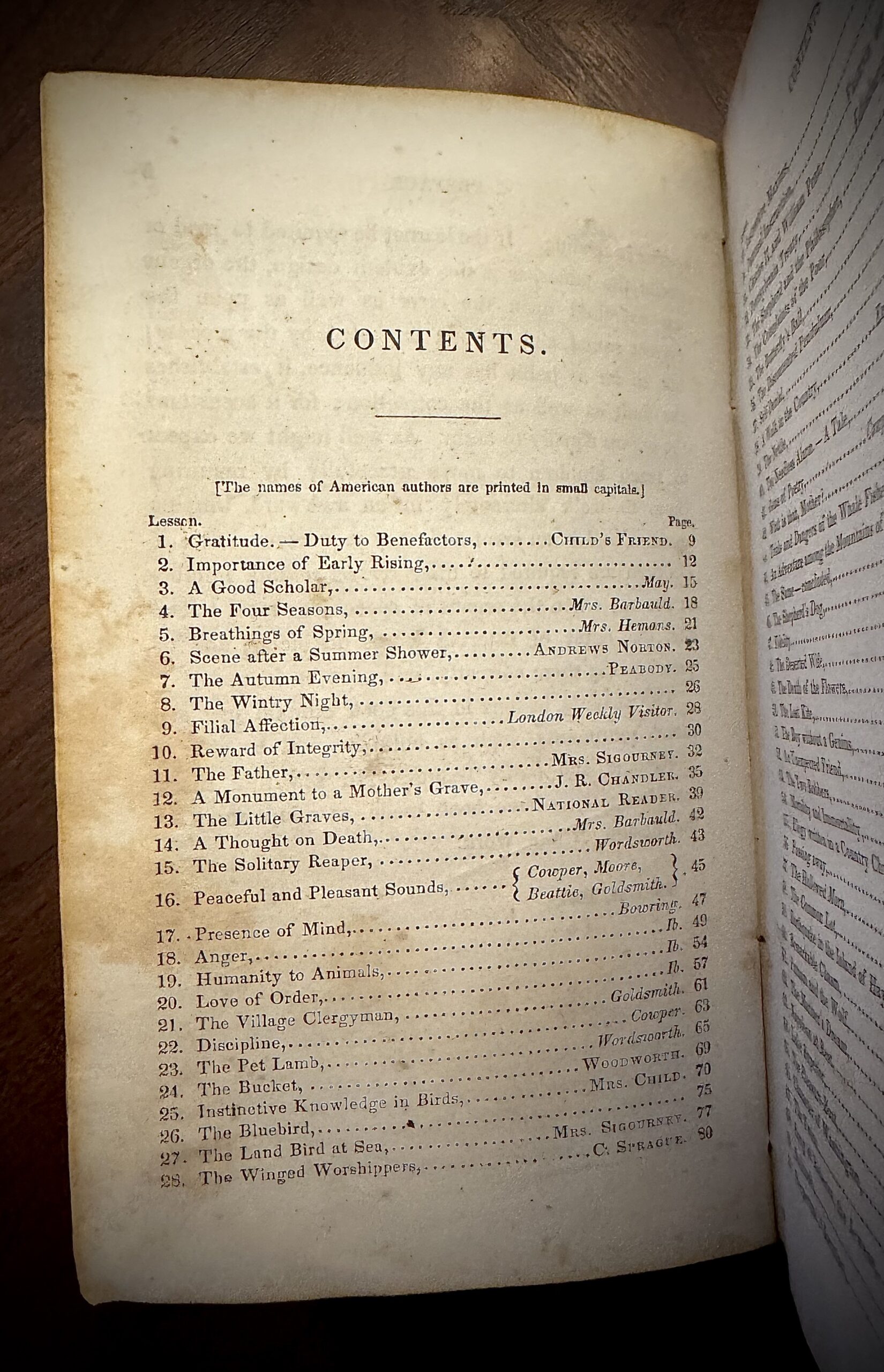
“Readers” were an important part of early attempts to standardize public school education. Different editions were available intended for different grades. “Grammar School Readers” such as this would contain short stories, poems, and lessons intended to teach not just reading and grammar but also moral behavior. The author, William D. Swan, is listed as being the principal of the Mayhew School in Boston, which was a grammar school in Boston in the 1800s.
This book states that it was entered into the Clerk’s Office of the District Court of Massachusetts in 1848 — similar to a modern copyright filing — which lines up with the publisher being named as Thomas, Cowperthwait & Co., a name only used in the 1840s-1850s. That would have been a few decades before my great-grandmother would have been born, but this still makes sense, as books in general were not as common during this period, and so school books in particular could be passed down through siblings and even generations, especially in rural NH where this book existed.
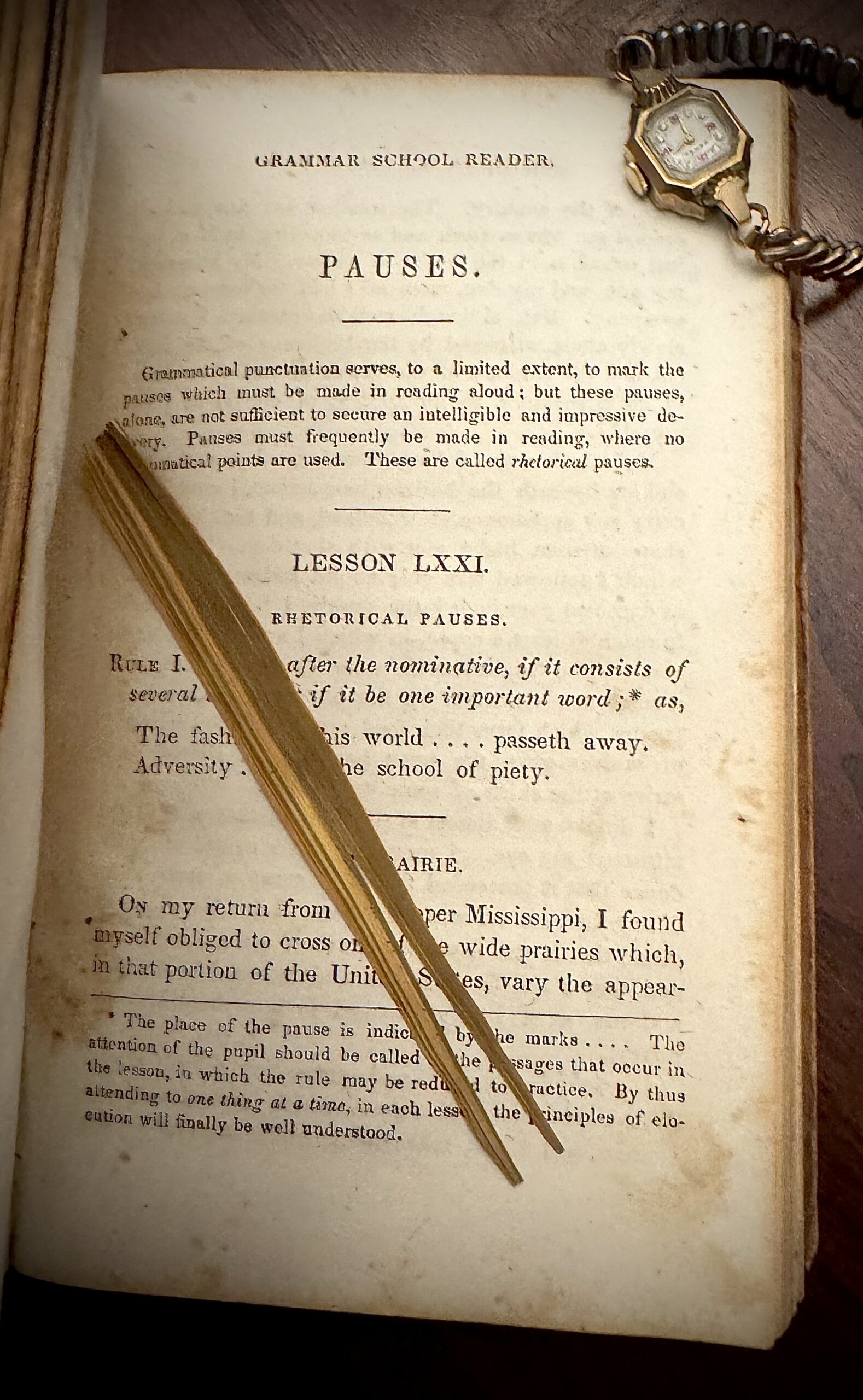
Tucked between the pages is what appears to be a palm leaf — used as a bookmark by either my mother or my great-grandmother and preserved between the pages!
Historical Context:
When this book was published, James Polk was President of the United States. There were 30 states, Wisconsin was the newest. The Mexican-American war, triggered by the annexation of Texas, ended in 1848. This book was printed during the period of time when the Oregon Trail was being heavily travelled for westward emigration, roughly 1846 – 1869.