
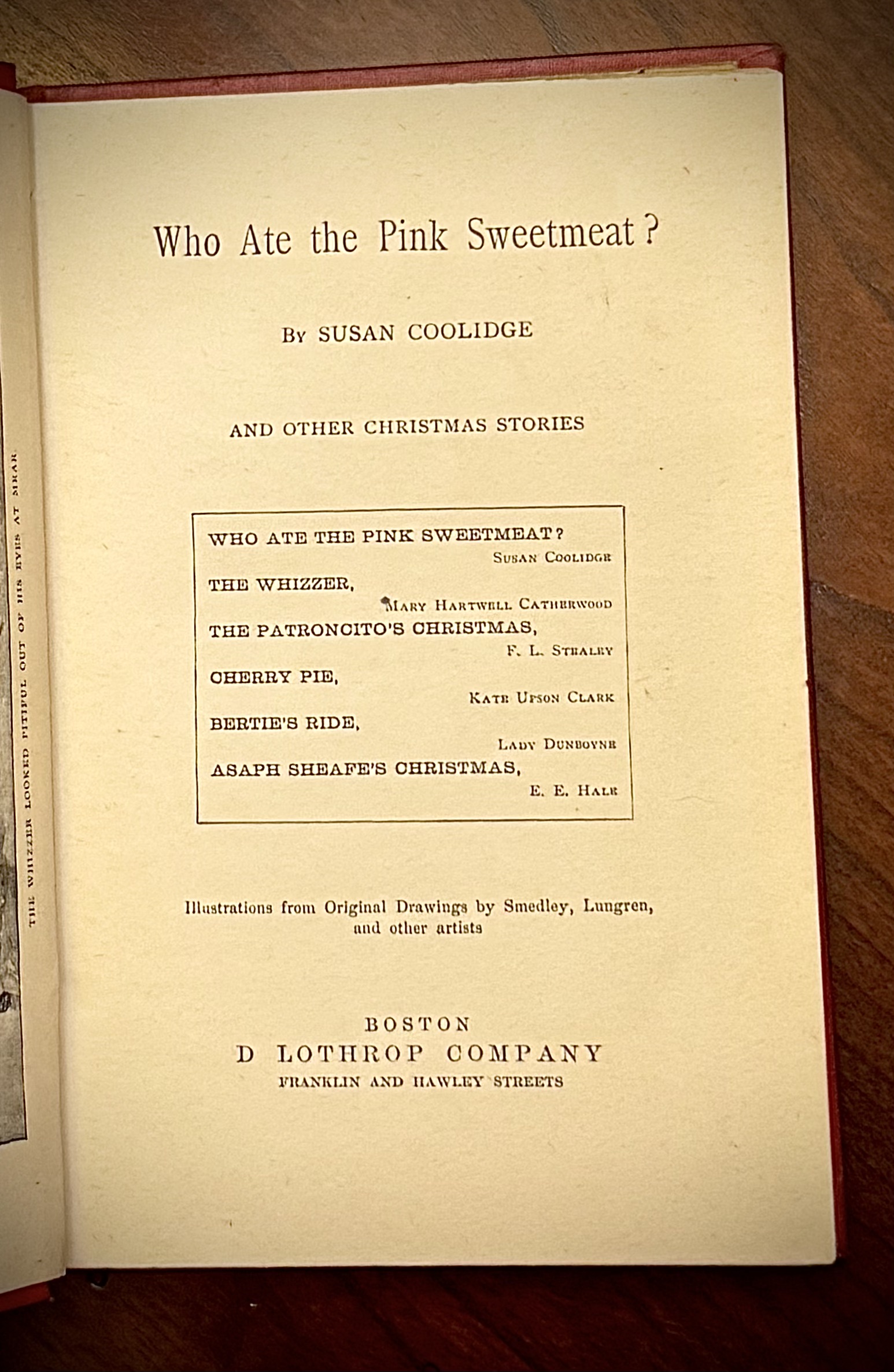

Title: Who Ate the Pink Sweetmeat? And Other Christmas Stories
Author: Susan Coolidge and others
Publisher: D. Lothrop and Company, Boston
Year of printing: 1887
Notes:
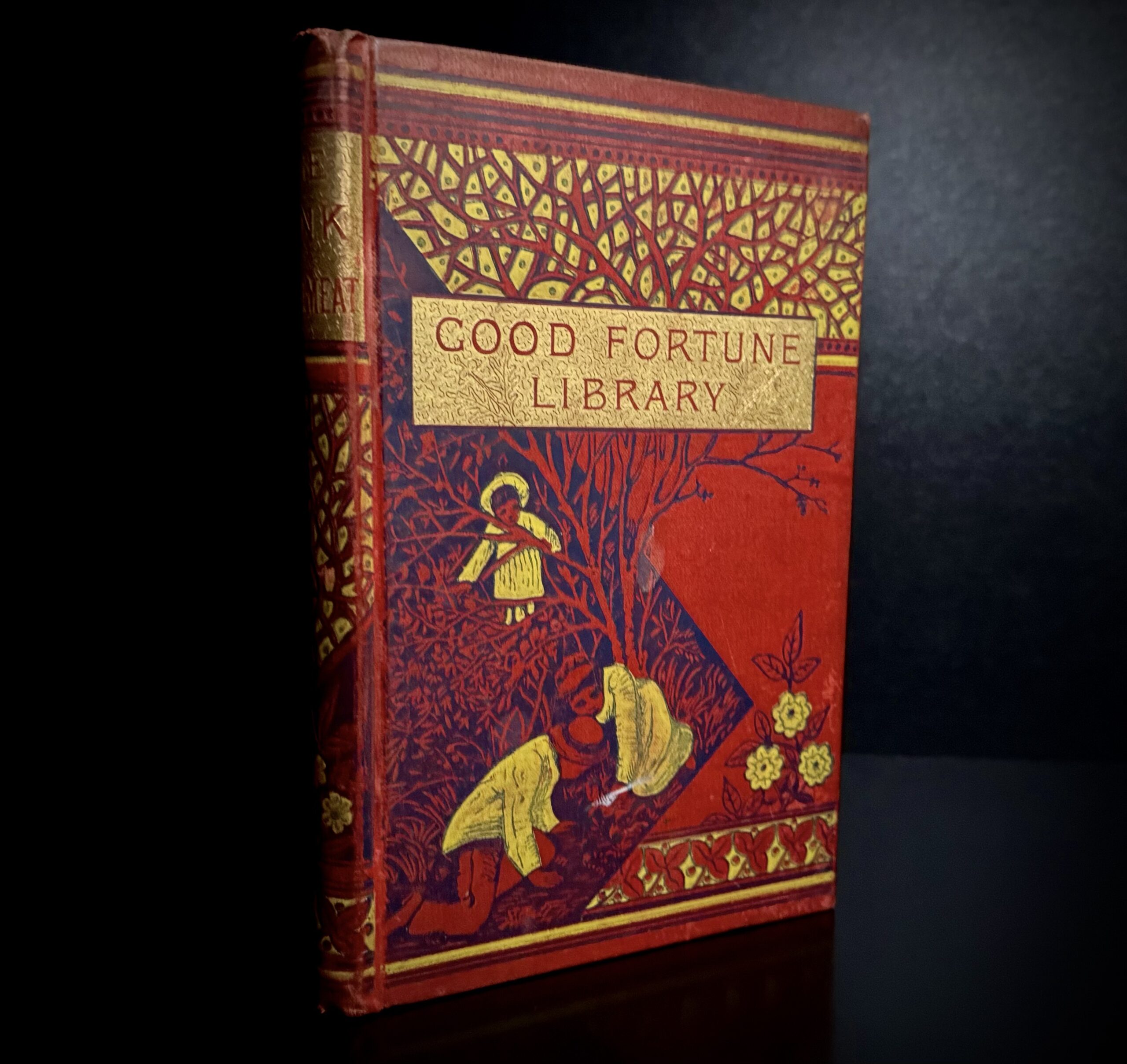
Even in the Victorian Era, there was a substantial commercial aspect of Christmas. Book publishers would capitalize on the gift-giving holiday by publishing special volumes collecting various Christmas-themed stories. This is one of those books — but what it contains is a delightfully strange selection of stories that have largely been forgotten.
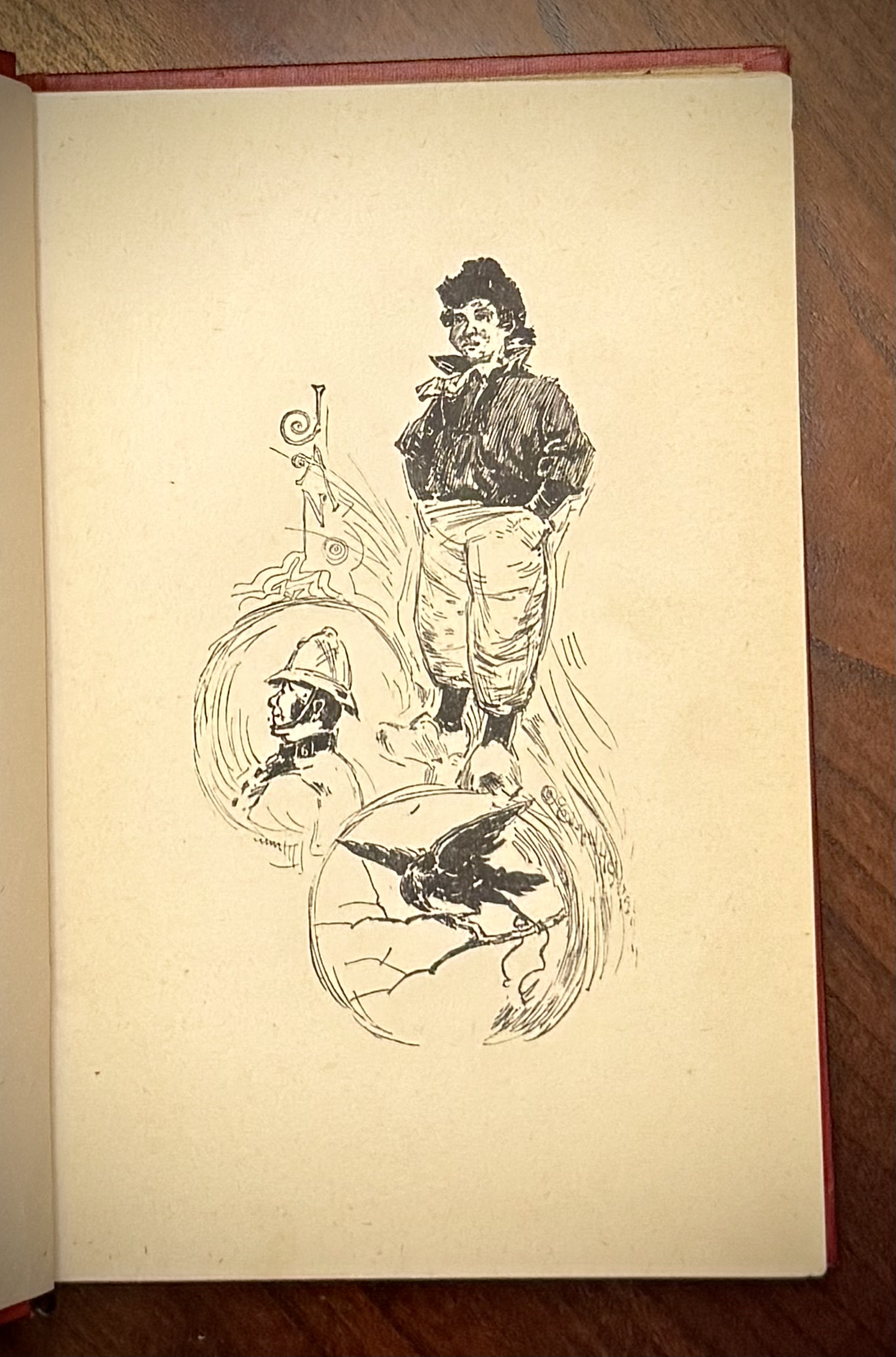
It kicks off with “Who Ate the Pink Sweetmeat?” (“Sweetmeat” was the word for candy at the time). Three children each receive a piece of candy for Christmas. One of them eats it right away, then regrets it. The second trades it away for some broken items, and also regrets it. The third holds onto the candy all day, joyfully thinking about who he might give it to, and eventually gives it to a policeman, who eats half while giving the other half to a bird stuck in a tree. Also of note, the story is told from the point of view of one of the Christmas stockings. The lesson here is to delay happiness now in return for future happiness — effectively a Puritan moral guidance tale. The author, Susan Coolidge, was actually a well known children’s author at the time, having written the popular What Katy Did series.
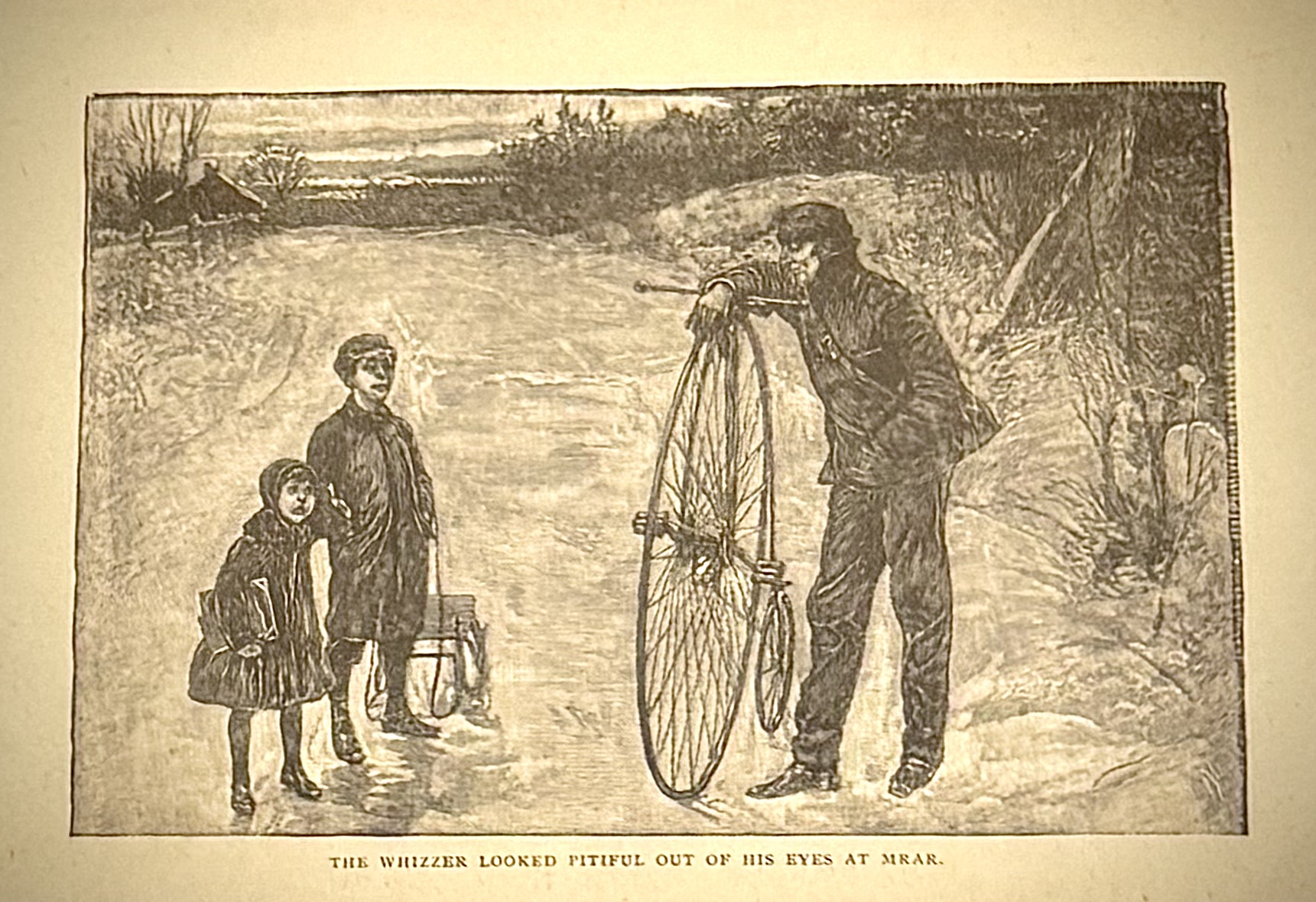
In “The Whizzer”, two children, whose parents recently died, are playing outside when a curious man on a bicycle (which was a relatively new invention at the time) approaches them. They join him on his bicycle, and he brings them quickly to their prior home, and prepares them a Christmas dinner. When the neighbors come looking for the children, the stranger reveals that he is, in fact, their father, whose death was just a misunderstanding.
“The Patrincito’s Christmas” is, by today’s standards, a racially insensitive story about a Native American who, in the spirit of Christmas, decides not to murder a young boy. “Cherry Pie” is a quick story about a young girl who brags about her grandmother’s cherry pie, then decides to invite her neighborhood friends over for some, thus forcing her grandmother to make another cherry pie.
“Bertie’s Ride” is about a young boy who ventures out into a snowstorm to mail a letter to his sister’s fiancé, who has been ignoring her previous letters. Bertie gets stuck in the storm, and miraculously encounters his sister’s fiancé, who is coming to visit for Christmas after all, and also saves Bertie’s life. “Asaph Sheafe’s Christmas” closes the book with a decidedly confusing story, about a young boy who breaks his Christmas gift to his mother while helping people around town, with a very unclear lesson.
These stories were each earlier published individually in the magazine Wide Awake, then first collected as the “Christmas Hearth Library” in 1884, and then republished here as the “Good Fortune Library” in 1887.
The book is inscribed “Ethelind Knapp”, about whom I couldn’t find much other than newspaper clipping from 1914 about her getting married in Buffalo.
Further Reading:
- 19th Century Juvenile Series – Good Fortune Library
- Fiction Mags – E. E. Hale
- Sarah Chauncey Woolsey – Wikipedia
- Ethelind Knapp marries Alfred Moss Roberts – Buffalo Sunday Morning News
Acquired August, 2026